










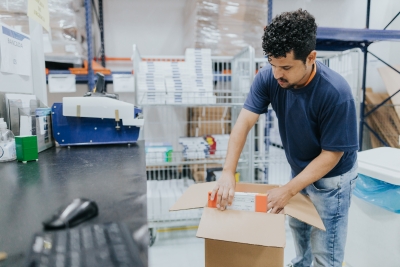
Our commitment to patient health goes beyond medical innovation. It recognizes the connection between environmental and human well-being. That’s why we’re working to reduce our carbon footprint and minimize waste across our supply chain.
As part of our goal to reach net-zero greenhouse gas emissions (GHG) by 2050, we are working toward reducing emissions by 50% by 2030. That progress has been driven by our efforts to reduce the environmental impact of our products across their full lifecycle — from design and sourcing to production, distribution and end of use.
Here are three key ways we’re doing that today for the benefit of patients, customers, employees and communities.
1. Advancing the rollout of digital instructions for use
Historically, our products have often included multi-language paper instructions that contribute significantly to total product and packaging weight. We have begun replacing that with paper versions of only the local language of customers receiving the device and, following a recent European regulatory update, are now working to convert to digital instructions for use (eIFU) where appropriate.
We played an active role in advocating for this update. Moving from paper to eIFUs is more than a regulatory change — it’s an opportunity to reduce environmental impact while improving the customer experience.
“With eIFUs, products include a single sheet directing customers to an online source for the most current instructions,” says Astrid Monteau, vice president, Europe, Middle East and Africa (EMEA), Endoscopy, and EMEA Environment, Social and Governance sponsor. “This shift reduces paper use and associated waste and emissions, enables faster updates for product notifications and can help reduce customer burden and simplify product handling.”
2. Innovating our product packaging
Our approach to sustainable packaging and labeling is guided by five principles and upholds product quality and regulatory compliance:
-
Reduce the amount of material used
-
Redesign packaging for sustainability and supply-chain efficiency
-
Improve recyclability and use recycled content where possible
-
Responsibly source materials in collaboration with suppliers
-
Monitor regulatory developments and advocate for sustainable packaging requirements
These principles inform decisions such as reducing carton weight, lowering carbon emissions across transportation and logistics, and increasing recycled content in packaging. For instance, we’ve diversified sourcing for carton paperboard used in our secondary packaging, or the outer box around a medical device’s inner package that protects it and provides information without touching the device itself. This has allowed us to employ more localized suppliers, shorten transportation distances and reduce emissions.
Because regulations shape what’s possible in packaging design, we closely monitor evolving requirements and advocate for policies that support more sustainable packaging solutions.
3. Implementing recyclable and renewable materials
We’re also exploring new ways to reduce reliance on fossil-based materials and recover value from products after they’ve been used.
A recycling pilot in Germany established a pathway for recovering and recycling single-use imaging devices, including LithoVue™ Single-Use Digital Flexible Ureteroscope, SpyScope™ DS II and EXALT™ Model D Single-Use Duodenoscope. In 2024, the pilot recovered approximately 1,000 devices, and data showed that recycling and material recovery from single-use endoscopes can reduce greenhouse gas emissions compared to incineration.
In addition, our LithoVue Elite™ Single Use Ureteroscope handles are now made primarily with bio-based plastic, with up to 85% of the material attributed to renewably sourced raw materials — offering a more sustainable alternative without compromising performance.
“By rethinking how we deliver instructions for use, redesigning packaging and investing in recyclable and renewable materials, we’re embedding sustainability into the way we innovate across the product lifecycle — for patients today and generations to come,” says Michelle Crozier, director, Global Sustainability.
Learn more about how we advance science for life by driving innovative care, empowering people and fostering a healthier planet.